Monday, 24 September 2012

Mephistopheles

Mephistopheles is a demon which derives from German folklore. The first appearance of Mephistopheles was as a Demon in the Faust legend, and has also been shown as the sterotypical Devil. He has been portrayed in a variety of different ways, whether it be in human form, a painting, a drawing or a modern cartoon...


This is one of my favourite images of Mephistopheles as I like the modern adaptation of it. The fire in the background could represent hell, and Mephistopheles is rising from it, in a stance almost as if he has a burning desire to attack. His clenched fists and large hands represent his strength and how he isn't afraid of anything. He looks very forceful here, almost as if he is breaking free from the chains that he is bound in. His piercing eyes create a sense of evil and destruction, and make the person looking at the picture feel victim to his power. The use of the colour red could show the adrenaline, energy and determination that Mephistopheles has within him. Another connotation of red is leadership, and Mephistopheles is the leader of hell, building up his very own empire.

Monday, 17 September 2012

The Life Of Christopher Marlowe

The ten key events in Christopher Marlowe's life are:

  1. His baptism- 26th February 1564. This is reflection of his religion, which was considered very important at the time.
  2. 1584- At the age of 20, he was awarded a scholarship at Cambridge and gained a BA. This could have been reflected in the prologue of 'Dr Faustus' "The fruitful plot of scholarism grac'd,
    That shortly he was grac'd with doctor's name."
  3. 1587- Saw Christopher change from medicine to literary work, where he moved to the Royal Court Circle. He spent time here gaining inspiration from Sir Walter Raleigh and Lord Admiral's Company of Players. He also wrote 'Tamburlaine the Great' in this year.
  4. 1588- 'Dr Faustus' was written.
  5. 1589- His writing was well underway with the publishing of the 'Famous Tragedy of the Rich Jew of Malta'. During this year, Marlowe was accused and charged with murder, though he was later declared not guilty.
  6. 1590- 'Edward the Second' written, as well as his most famous work 'The Passionate Shepherd to His Love', which was said to be follwed up by a poem by Sir Raleigh, titled 'The Nymph's Reply to the Shepherd'
  7. 1592- 'Hero and Leander' written
  8. Early 1593-'Massacre at Paris' was acted on stage.
  9. Early May 1953- Thomas Kyd arrested due to implying Marlowe was an Atheist and heretic. Warrant for Marlowe's arrest after being accused of heresy.
  10. Late May 1953- Marlowe was said to have passed away on the 30th May, reportedly after arguing with friends he was stabbed in the eye which caused his death.

Thursday, 6 September 2012

Faustus Prologue

The prologue tells us how Faustus was born into a poor, working class family, and was his “parents base of stock”. This could be interpreted that he acted as the building blocks, his parent’s only hope of accessing the money they needed in order to survive. He later went on to Whittenberg, where his intelligence gained him a “scholarism” and he was “shortly graced with a doctor’s name”. This is significant as it reflects his intellectual abilities. He “excelled all”, and it takes many years to acquire a doctorate qualification, which could show that Faustus has some sort of ‘power’ or ‘supernatural’ talent which allows him success. This could link to him being “cunning of a self-conceit” showing his vast amount of knowledge yet his arrogance towards others and the world, his big-headed and cocky personality. He is described as having “waxen wings”, which links to Greek mythology, the tale of Icarus and his overreaching ambition which lead him into his death, “melting” from the heat of the sun. Could this be foreshadowing Faustus’s life? If he “surfeits upon cursed necromancy” and believes that “nothing” is “so sweet as magic to him”, could he be entering a dangerous and risky world of magic? Could this “cheifest bliss” be joy in hell rather than heaven...

'Doctor Faustus', Source: anitasullivan.co.uk


Monday, 2 July 2012

Short Gothic Story- No Escape

No escape

The storm was raging. With every lightening bolt, I felt another shock of terror surge through my body. By the time it was over, I was frozen with fear…
I heard his footsteps approach me. There was no escape now. The light of the moon beamed down and accentuated his ghastly grimace. I recognised his face from somewhere, but where from? It was a combination of all the horror films I had ever watched, yet this was reality. I was alone, isolated, paralysed in my real-life nightmare.  Gradually, his bony hand glided up my body, his long, sharp fingernails made my skin crawl. He stopped at my neck. As his hand gripped tighter with every breath I took, the pressure built. I realised his intentions. He was the serpent and I was the mouse, the predator and prey. Powerless and unprotected, I envisaged my fate, for there was no escape. His breathing got louder and deeper and my death was on the horizon. I heard screaming. I wasn’t alone. His face dropped, and without haste he let go of my neck and ran out of the room.  Within a few seconds, the screaming had stopped. Silence.

Thursday, 28 June 2012

Gothic Symbolism and Representations of The Gothic

The symbols of 'The Gothic' are very distinctive. One of the most common is the colour- black. This symbolises the night, evil, mystery, sadness, remorse, unhappiness and mourning. Ironically, these features are popular themes within Gothic literature. Black can also be seen to express a sense of the 'unknown' or supernatural. As shown in the 'Gothic fasion' post, black is what Goths typically wear. Secrecy could also be represented by black, keeping things in the dark or hidden away.


Pentacle. Source: ayro91.deviantart.com
 Above:This 5 sided star shape represents the elements understood by the Pagans: Air, Earth, Wind, Fire and Water. This symbol can be used in Gothic cultures to represent Satan or death.


Below: An ankh. This symbol demonstrates a strong cultural significance, and is sometimes seen as the key of life. In Egypt, this is used the soul of the dead to a new life.


Tuesday, 19 June 2012

Gothic Architecture


View of the South transept of Notre Dame, Paris, France. Source: brusselspictures.com

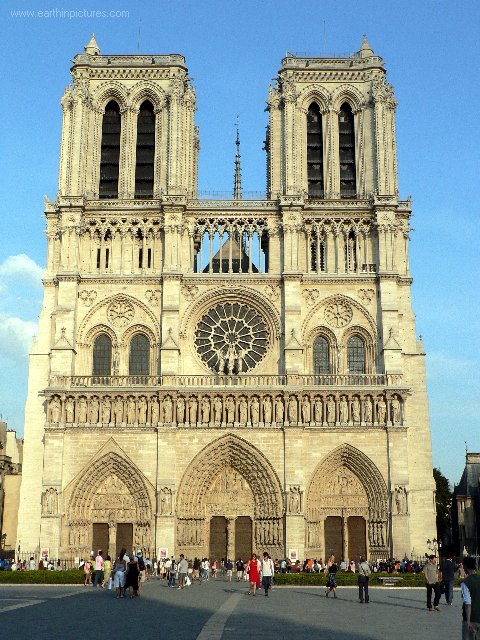
 Gothic architecture became popular during the medieval period.  It evolved from a combination of Romanesque and Renaissance architecture. The most obvious and prominent feature of Gothic architecture is the pointed arch, and is component to many abbeys, cathedrals and churches of the 12th Century era. Notre Dame in Paris is one of the most famous examples of Gothic architecture, and was completed in 1935.


Notre Dame, Paris, France. Source: earthinpictures.com


This view of Notre Dame shows the popular pointed arch feature common to these Gothic inspired buildings. These arches evolved from the round arches commonly round in Roman architecture. These arches were purpose built for two specific reasons. The first reason was that the arch is able to reach higher for a given width. The second reason could be seen as a defence mechanism, as they are less visible. This is an important factor when constructing masonry walls, as Gothic arches only produce half the side-thrust of Roman arches...but that's too technical for English literature.


The interior design of Notre Dame. This picture shows how the Gothic design and layout is an interior feature and attraction as well as exterior. The colour scheme also gives a Gothic feel, with dark and dimmed lights, and the use of red for the seating. There is a sense of danger and eeriness which has been carefully created for a purpose, adding a sense of mystery. Source: worldtouristhotspot.blogspot.com


The Gothic arch feature is demonstrated in this photo. The dark colours are carried on throughout the Cathedral, with lighter colours used for 'The Temple Of Reason'. Source: europeantrips.org


'The Temple Of Reason', Notre Dame. Gothic pointed arches are part of this attraction, as are the spikes and turrets. Source: laundelles.wordpress.com


Other examples of Gothic Architecture are:

Sainte Chapelle, France. Source: norstad.org/paris2006/chapelle

Gargoyles are a common feature of the Gothic as they are supernatural and scary. They create a sense of evil and danger, almost devil-like. Source: wishlist.nu/2007/10/22/gargoyle


Royaumont Abbey, France. Source: en.structurae.de


Monday, 18 June 2012

Gothic Fashion


Gothic Fashion, 'ALL BLACK BEAUTY', ELLE, elle.com
In recent times, when the word 'Goth' is used, many of us think of a subculture of people dressed in black clothing, drained of colour. Platform shoes, cloaks, chains, piercings and tattoos. Leather, netting, lace. Thick black eyeliner, pale face.

Girl Above: Tattoos and staple piercings on her arms represent her Gothic nature. Smeared makeup creates the emotion of distress and sadness. Skull could represent death. Source: gothic-nature.com
Man Above: Pale/white face make-up with black eyeliner and eyeshadow which is stereotypical of Goths. The blue coloured contacts create a sense of mystery and fear. Facial piercings are common amongst this culture, but may be seen as abnormal or deviant to many. Source: thestoryofshopping.blogspot.com


However, it is not all doom and gloom. This group of Goths below have incorporated red and purple into their outfits. Red can been seen to have connotations of anarchy, danger and revolution. Purple can create a sense of mystery, spirituality, and in some countries even the colour of mourning the dead. The location of the photo is significant- a graveyard. This adds a ghostly sense to the photo, the rising dead. This can be contrasted with the background bursting with nature, new life and colour.